With Ernst behind the wheel, our bus trip continued on across Belgium and into France. Terry told us about the military struggles that took place here during WWI.
On this 1914 map below one can easily trace our route by drawing a line from Brussels to Paris. The Western Front in 1918 is shown in map.
We arrived in Paris amidst heavy traffic and much horn honking, but Ernst skillfully made his way to the Sacre Coeur. From below we looked up at the majestic basilica.
After ascending the mount up umpteen steps, we witness the splendor of Paris below us.
A mass was being conducted in the Basilica so we walked inside as observers. Organ music provided the background for my video tape as I scanned the beautiful interior of the church. The church was a curious mixture of Romanesque and Byzantine.
As we walked back to the bus we noticed that Paris must have a lot of doggies and understood why it is called the dog poop capital of the world. We learned to watch where we stepped.
Ernst had to drive a ways from the downtown to reach our lodging place called the Climat. The place had large wooden shutters and an unfriendly staff. Here we learned about French nice when we enquired about having a second hard (hard) roll -- you'd think we asked for the establishment. A simple no would have sufficed.
June 18th, Thursday
Ernst parked the bus along the Seine River so we could walk across a bridge to visit the Norte Dame Cathedral. In 1793, during the French Revolution, the cathedral was rededicated to the Cult of Reason, and then to the Cult of the Supreme Being. During this time, many of the treasures of the cathedral were either destroyed or plundered. The statues of biblical kings of Judah (erroneously thought to be kings of France) were beheaded.
Many of the heads were found during a 1977 excavation nearby and are on display at the Musée de Cluny. For a time, Lady Liberty replaced the Virgin Mary on several altars. The cathedral's great bells managed to avoid being melted down. The cathedral came to be used as a warehouse for the storage of food.
Napoleon restored order and restored the Cathedral to the Catholic Church. Picture on right... December 1804: the coronation ceremony of Napoleon I and his wife Josephine, with Pope Pius VII officiating. However, Napoleon upstaged the Pope by crowning himself.
Notre Dame de Paris was among the first buildings in the world to use the flying buttress (arched exterior supports). The building was not originally designed to include the flying buttresses around the choir and nave. After the construction began and the thinner walls (popularized in the Gothic style) grew ever higher, stress fractures began to occur as the walls pushed outward. In response, the cathedral's architects built supports around the outside walls, and later additions continued the pattern
These demon looking creatures carved out of stone are called gargoyles, one of the many eerie stone figures that adorn the gutters of the Cathedral of Notre Dame in Paris. Gargoyle comes from a Latin word, meaning gullet or drain.
On this trip we did not go into the Les Invaldes, but were content to view it from the outside. Louis XIV initiated the project by an order dated November 24, 1670, as a home and hospital for aged and ailing soldiers
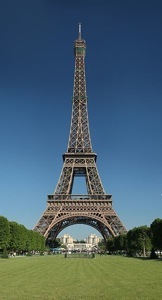
Our mode of transportation was the subway. Of course we had to go up the Eiffel Tower. The structure was built between 1887 and 1889 as the entrance arch for the Exposition Universelle, a World's Fair marking the centennial celebration of the French. The tower was much criticized by the public when it was built, with many calling it an eyesore. The City had planned to tear it down (part of the original contest rules for designing a tower was that it could be easily demolished) but as the tower proved valuable for communication purposes, it was allowed to remain after the expiry of the permit Today it is considered a work of art.
We rejoined the bus and passed the Arch of Triumph. This is the Largest Triumphal arch in the world. It was conceived by Napoleon in 1806 to honor the imperial armies. The Tomb of the Unknown Soldier is beneath the monument.
Ernst let us off at the Opera House, which would become our common meeting place in Paris. Understandably, it often referred to as the most beautiful building in the world. It was built by order of Napoleon III in the style of the Second Empire.
The Grand Foyer.
The interior consists of interweaving corridors, stairwells, alcoves and landings allowing the movement of large numbers of people and space for socializing during intermission. Rich with velvet, gold leaf, and cherubim and nymphs, the interior is characteristic of Baroque sumptuousness.
We waited here at the Opera House for our EF bus which would take us out to
Versailles. We arrived around lunch time so we ate at a cafe outside the gates -- sampling some French food. After lunch we entered through the gates into the giant courtyard.
It seemed fitting that there would be a statue of Louis XIV placed prominently in front of the palace. He settled on the royal hunting lodge at Versailles and over the following decades had it expanded into one of the largest palaces in the world. In 1862 his court of 20,000 persons moved into Versailles.
Here social,life was soon ordered by a rigorous code of etiquette -- providing a means of keeping the nobles harmlessly occupied. The court of Versailles was the centre of political power in France from 1682, when Louis XIV moved from Paris, until the royal family was forced to return to the capital in October 1789 after the beginning of the French Revolution.
We spent considerable time admiring the massive landscaped gardens with ponds, fountains and even farmyards. Marie Antoinette used to romp here with her perfumed lambs before the French Revolution.
The best came last, the interior of the Palace. Unbelievable. Like the Hall of Mirrors
The Chapel
Even the royal bedrooms
Upon our return to Paris, we went over to the Louvre by way of the Garden of the Tuileries. The statues and flowers made for a pleasant walk.
Then we approached the entrance to the Louvre with the famous glass pyramid. We did not go inside because that activity was scheduled for tomorrow. We crossed the Seine to rejoin with the other school in our tour and to eat lunch in a nice French restaurant.
Having satisfied our hunger, we embarked on boat trip of the Seine River that started by the bridge.
Touring Paris via the Seine River is a great way to get familiar with many of the city's most stunning monuments, historical buildings, and ornate bridges, including the
Eiffel Tower and every possible view of the Norte Dame Cathedral.
Of special interest was the
La Conciergerie, a former royal palace and prison in Paris, During the French Revolution its cells were occupied by thousands of citizens who lived out their last hours here before being carted off to the guillotine. Marie Antoinette was among them.
June 19th, Friday
After our traditional hard roll for breakfast,Ernst drove us down to the
Louvre. We experienced French “nice” when we tried to store our things at the entrance. The obnoxious lady at the counter deliberately held us up. Even with Terry pleading with her in French she made our museum entry painful. I became convinced that all those things in the tourist books that were derogatory about the French were true.
One could spend weeks looking at thee famous masterpieces. The artwork included (from left to right) the
Nike of Samothrace 190 BC, Liberty Leading the People by Eugene Delacroix...
and the
Mona Lisa by Leonardo da Vinci. On the video tape I have many, many great works by Ingres, Van Dyke, Rueben's, Vermeer, David, Hals, Rembrandt and so on. Annette found much for her graduate work credits.
We were not Done yet. Ahead of us was a tour of the Museum d’ Orsay, which houses the greatest collection of Impressionism in the world. The museum building was originally a railway station, Gare d'Orsay, had constructed. By 1939 the station's short platforms had become unsuitable for the longer trains that had come to be used for mainline services. In 1977 the French Government decided to convert the station to a museum. The museum itself is a beautiful work of art. Among the treasures on display were the Church at Auvers by Van Gogh,
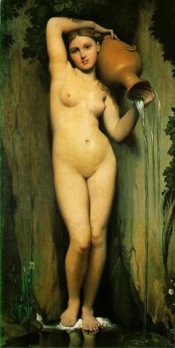
Jean Auguste Dominique by Ingres,
Whistler’s Mother by Whistler
... and the
Gleaners by Millet.
Our next museum was an outdoor museum -- The Rodin Museum. Here the art work was arranged to so one could walk among them. The Musée Rodin is a museum that was opened in 1919 in the Hotel Biron and surrounding grounds. It displays works by the French sculptor Auguste Rodin:
The Thinker,
The Calais Burgers
...and
The Lovers.
We returned to the Hotel des Invalides, but this time to enter and tour the site.
The most notable tomb at Les Invalides is that of Napoleon Bonaparte (1769–1821). Central tomb on right. Napoleon was initially interred on Saint Helena, but King Louis-Philippe arranged for his remains to be brought to Paris in 1840; finally in 1861 Napoleon was moved to the most prominent location under the dome at Les Invalides. His son, Napoleon II who died at an early age, is also entombed there in the circular walk on the lower level
June 20th, Saturday
We left Paris fora trip to Chartes, the Loire Valley and Tours. First we reached Chartes to visit the great Norte Dame de Chartes Cathedral. This edifice is considered one of the most celebrated churches in the world.
The side of the church with its buttresses.
Ornate entrance
Famous stained glass windows. All the windows wer taken out in 1919 during WW I and also in 1939 during WW II. Both times they were put back in when peace returned
Massive pillars
After considerable time viewing the church, we walked around the central square of Chartes.
Ernst drove the bus on to
Chaumont located twelves mile from Chenonceau and situated along the Loire River. The Château de Chaumont was purchased by Catherine de Medici in 1560, a year after her late husband Henry II's death. There she entertained numerous astrologers, among them Nostradamus. In 1559 she forced Diane de Poitiers, her late husband's long-term mistress, to exchange the Château de Chenonceau for the Château de Chaumont. Diane de Poitiers only lived at Chaumont for a short while.
When I taught European history at the college, I spent considerable time on the Age of Catherine Medici. She ran France during the reigns of her three worthless sons.
Our main interest was
Chateau (or Castle) Chenonceau. Henry offered the château as a gift to his mistress, Diane de Poitiers, who became fervently attached to the château along the river. She would have the arched bridge constructed, joining the château to its opposite bank. She then oversaw the planting of extensive flower and vegetable gardens along with a variety of fruit trees. Set along the banks of the river, but buttressed from flooding by stone terraces, the exquisite gardens were laid out in four triangles.
The grand gallery, which extended along the existing bridge to cross the entire river, was dedicated in 1577. During WW I it was used as a hospital to treat wounded soldiers. In World War II it was in the German occupied region of France.
We left this beautiful place and moved on to Tours, the chief town of the Loire Valley.
First thing we did was to check in at the Grand Hotel.
Becky Klann shown here with her parents who had given her this trip as a gift.
After dinner at a fancy French restaurant, Terry took us on a walking tour of Tours. We walked along streets with half-timbered buildings.
Then along the Loire River which was the boundary between Vichy France (this side) and Occupied France in WW II. The city had a nice paved walkway for us.
Gothic Cathedral of’ St. Gatien.
Note the buttresses evident on view of the apse.
June 21st, Sunday
Back on the road again -- toward Switzerland. We stopped at a charming French village of Bellegarde to see the Chateau de Bellegarde. Then back on the bus.
Our last stop in France was in Beaune, right in the heart of Burgundy. Our highway was A6 and we
were coming in from the north.
Naturally we ordered wine with our lunch. Terry helped us with the French language.
Courtyard of Hospices de Beaune
Savigny les Beaune
The old city walls were noticeable both as we entered the city and as we left. Impressive.
Continuing on through the Alsace region we drove through Mulhouse (upper left on map below) before reaching the customs on the border of Switzerland.
Clearing customs we drove on to Lucerne, Switzerland.
Once in Lucerne we pulled up to a really nice hotel called the Kreuz. We washed clothes and then held a worship service conducted by Mike Lindemann. The beds in the hotels were great and we loved the feather blankets. The hotel was family owned and had a by-gone charm. Shutters on the windows.
June 22nd, Monday
First thing after waking we walked out onto our patio to view the neighborhood. We had an old style breakfast with juice; then cheese and meat to go with our rolls. The cheese was outstanding.
We started out our tour of Lucerne by visiting the famous Lion Monument by Thorvaldsen. It commemorates the Swiss Guards who were massacred in 1792 during the French Revolution, when revolutionaries stormed the Tuileries Palace in Paris, France. The American writer Mark Twain (1835–1910) praised the sculpture of a mortally wounded lion as "the most mournful and moving piece of stone in the world."
Our local guide (required by law) took us on a walking tour of the city that encompassed beautiful quaint fountains, ornate buildings and narrow streets. Mike Lindemann tested the fountain water to see if it was drinkable. He liked it! He liked it!
We crossed the river to visit San Xavier, a Jesuit church of the Counter-Reformation. Lucerne is almost entirely Catholic although Protestant Zurich is only miles away. The church is located on the river, lower portion of map.
This baroque church has a beautiful exterior.
Fortunately we were able to view the interior of this church as well. The nave and the high altar are all covered with a white stucco that appears to be marble. Stunning beauty.
Our guide then had us walk to the river front and then over to the Chapel Bridge. One of the city's famous landmarks is the Chapel Bridge (Kapellbrücke), a wooden bridge first erected in the 14th century.
Part way across, the bridge runs by the octagonal Water Tower (Wasserturm), a fortification from the 13th century. Inside the bridge are a series of paintings from the 17th century depicting events from Luzern's history. One of the stories was that of William Tell.
After walking across the bridge, we were given free time to browse. Most of us took in the Bucherer building. It was in 1888 that businessman and industrialist Carl-Friedrich Bucherer opened his first watch and jewelry store in Lucerne, Switzerland, thus laying the foundations for a successful family business. This was a shopper’s paradise. Free spoons were given out as a promotion.
We had big plans for the afternoon. At a designated time we met at the dock and boarded a ship that would take us to the foot of Mt. Pilatus. To our right we could see the giant mountain.
Operating from May to November, this thrilling rail ride starts at the mountain’s base in Alpnachstad and runs over uniquely constructed tracks to the mountain’s summit—a sweeping panoramic delight of over 70 peaks and five lakes.
The ride down was via cable car. That was a strange feeling to be suspended over such dizzying heights.
You could describe the views as breathtaking.
June 23rd, Tuesday
On our way to Germany we stopped at Zurich to witness the thundering Falls of the Rhine River. The Rhine Falls near Schaffhausen are Europe's biggest,
The Rheinfallfelsen, a large rock, is the remnant of the original limestone cliff flanking the former channel. The rock has eroded very little over the years because not too much sediment comes down the Rhine from Lake Constance in Germany.
GO ON TO 1992 FRED’S COLLEGE TOUR PART III GERMANY & AUSTRIA